
Welcome back to the Epoch Brief! It’s been longer between Briefs than usual, so buckle up for a rich edition.
Here’s the full rundown:
An in-depth report on Huawei’s AI chip roadmap and production capacity, and how it will stack up with Nvidia this decade.
An Nvidia-sized hole in US GDP statistics: official figures miss most of the value Nvidia adds to the US economy, understating GDP growth by roughly 0.3 percentage points over the past year.
We found evidence of significantly different architectural choices underlying GPT and Claude models by analyzing how the speed of their responses scales differently at long-context lengths.
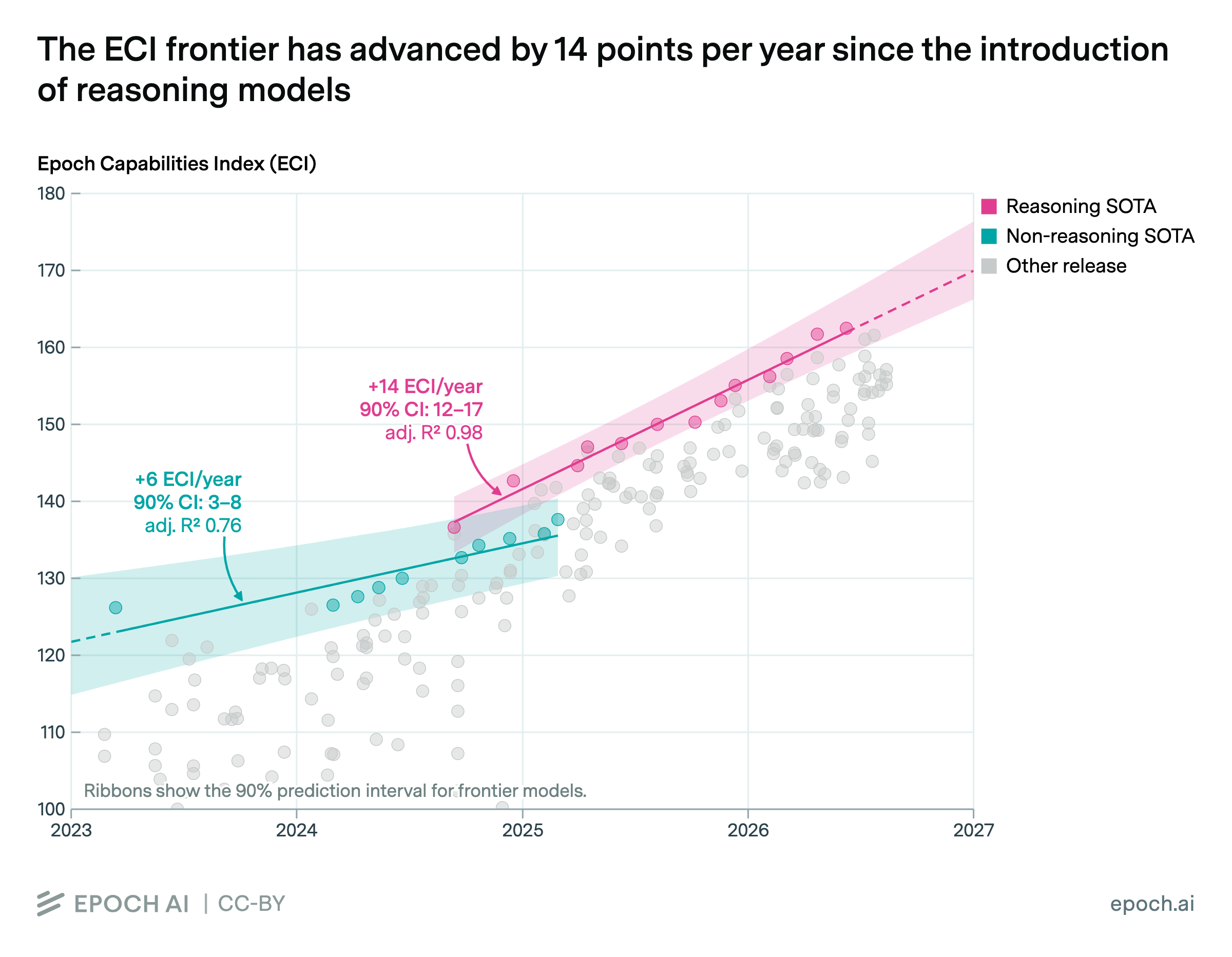
Two Data Insights: the record for the largest AI data center by power capacity has doubled every 10 months, and the top score on the Epoch Capabilities Index (ECI) has advanced by 14 points per year since the introduction of reasoning models.
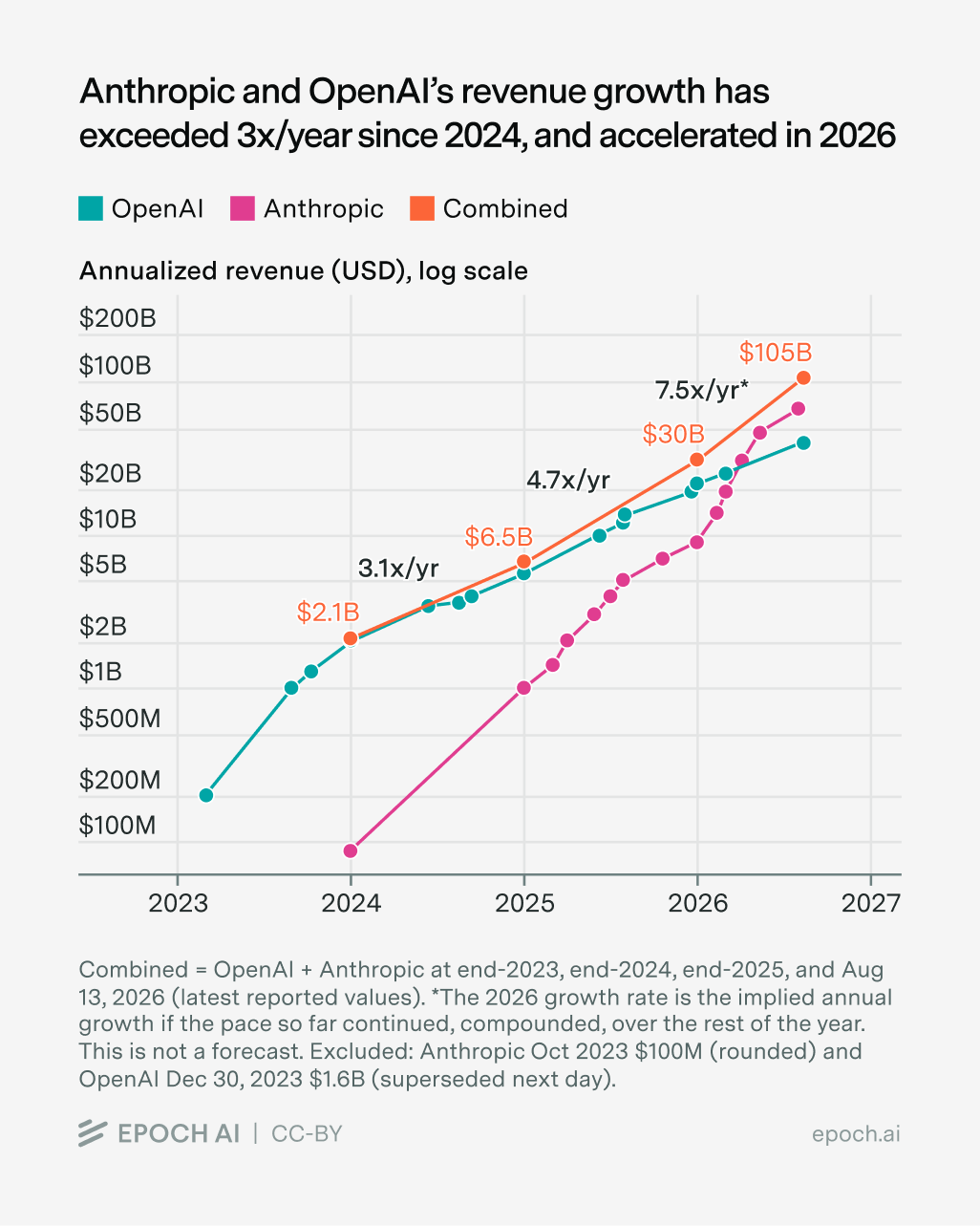
An update on the accelerating revenues of Anthropic and OpenAI, and whether they are sustainable.
A pre-release evaluation of GPT-6 Astra, which set new records on the Epoch Capabilities Index (ECI) and on our math, continual learning, and game-puzzle benchmarks.
FrontierMath Erdős, our newest math benchmark comprising 68 unsolved Erdős problems formalized in Lean. Only OpenAI’s new GPT-6 Astra has made any progress thus far, with 2 solves.
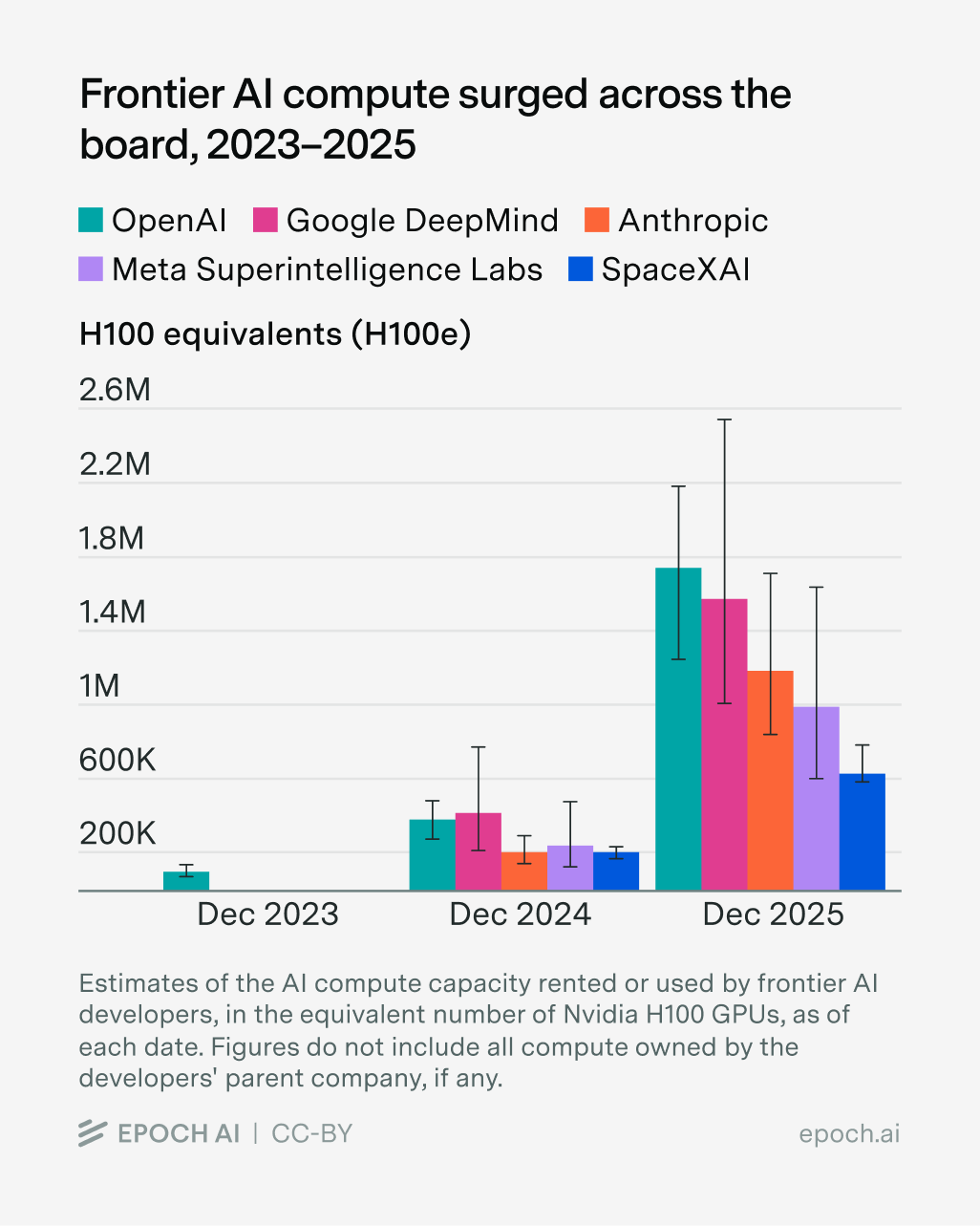
The AI Chip Users explorer, which compiles our estimates of the exponential growth in compute used by leading AI developers.
And we’re hiring across seven roles, including research, engineering, design, and writing.
Research
Will Huawei catch up to Nvidia by 2030?
In a new report, researcher Venkat Somala analyzes the chip roadmap and supply chain of China’s leading chip designer, Huawei, from the Ascend 950 to its 3D-stacking bet and domestic HBM supply. The results show a steep path for Huawei to compete with industry leader Nvidia. To begin, Huawei is far behind: its most powerful chip has roughly half the arithmetic performance of the H100, which Nvidia began shipping in 2022, and it will likely produce less than 4% of Nvidia’s AI compute in 2026.
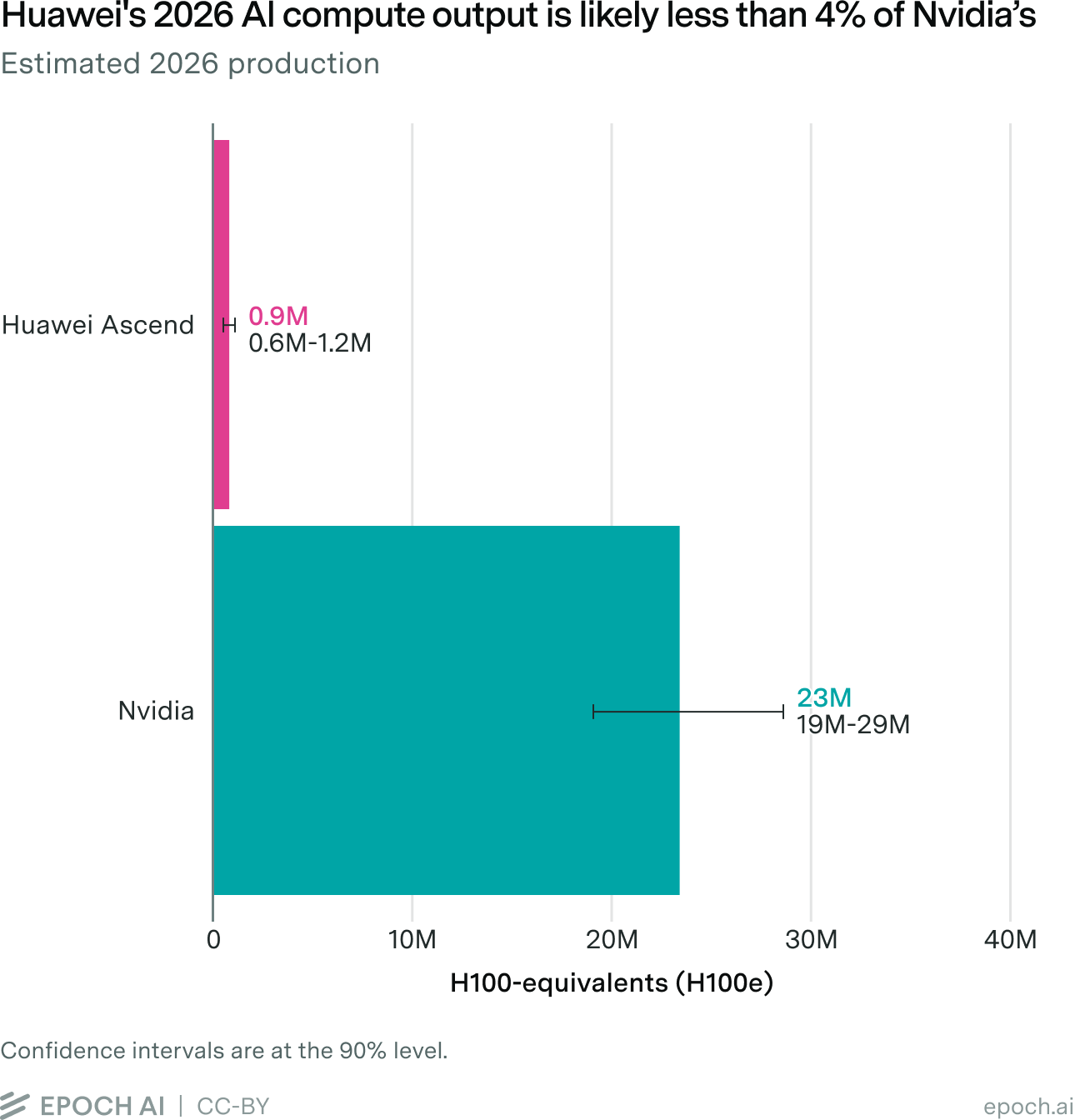
Huawei has announced an ambitious roadmap, but the two main levers it could pull to close the gap — improving per-chip performance and increasing the total volume of chips it ships — are both constrained by export controls. Even if Huawei delivers on its roadmap in full, it’s almost certain that it won’t catch Nvidia this decade.
The Nvidia-sized hole in US GDP statistics
Our research team, led by senior researcher Isabel Juniewicz, discovered that US GDP statistics miss most of the value Nvidia adds to the US economy. As a result, GDP growth has been understated by ~0.3 percentage points over the last year. The finding helps answer a persistent question mark hanging over the AI boom and its economic impact.
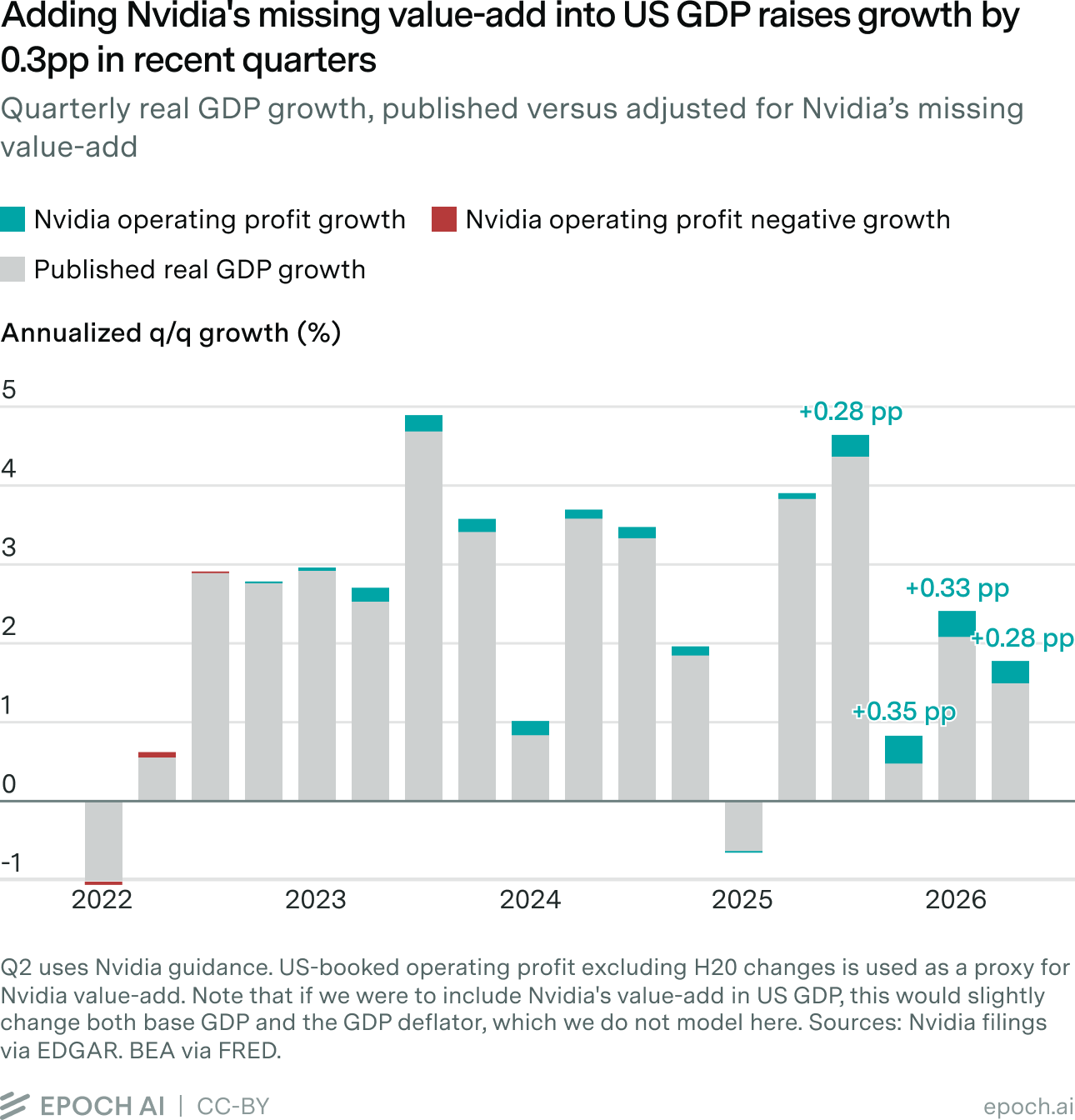
The question: Why is it that, while US investment in computing equipment has risen to roughly $400 billion per year, nearly triple its 2023 level, the measured impact on GDP growth has remained modest? Our report finds that GDP statistics have a blind spot around the value American firms, most notably Nvidia, create by designing AI chips that are manufactured and sold abroad. As a result, AI’s contribution to US GDP is substantially underestimated.
Long-context latency scales quadratically for GPT-5.6 but nearly linearly for Claude 5
OpenAI GPT-5.6 models and Anthropic Claude 5 models have different pricing structures at long context lengths. GPT model costs increase in price past 272k input tokens, while Claude model costs remain fixed. In a new report, researcher Jason Li investigates whether this corresponds with underlying architectural differences between the model families, and his measurements suggest it does.
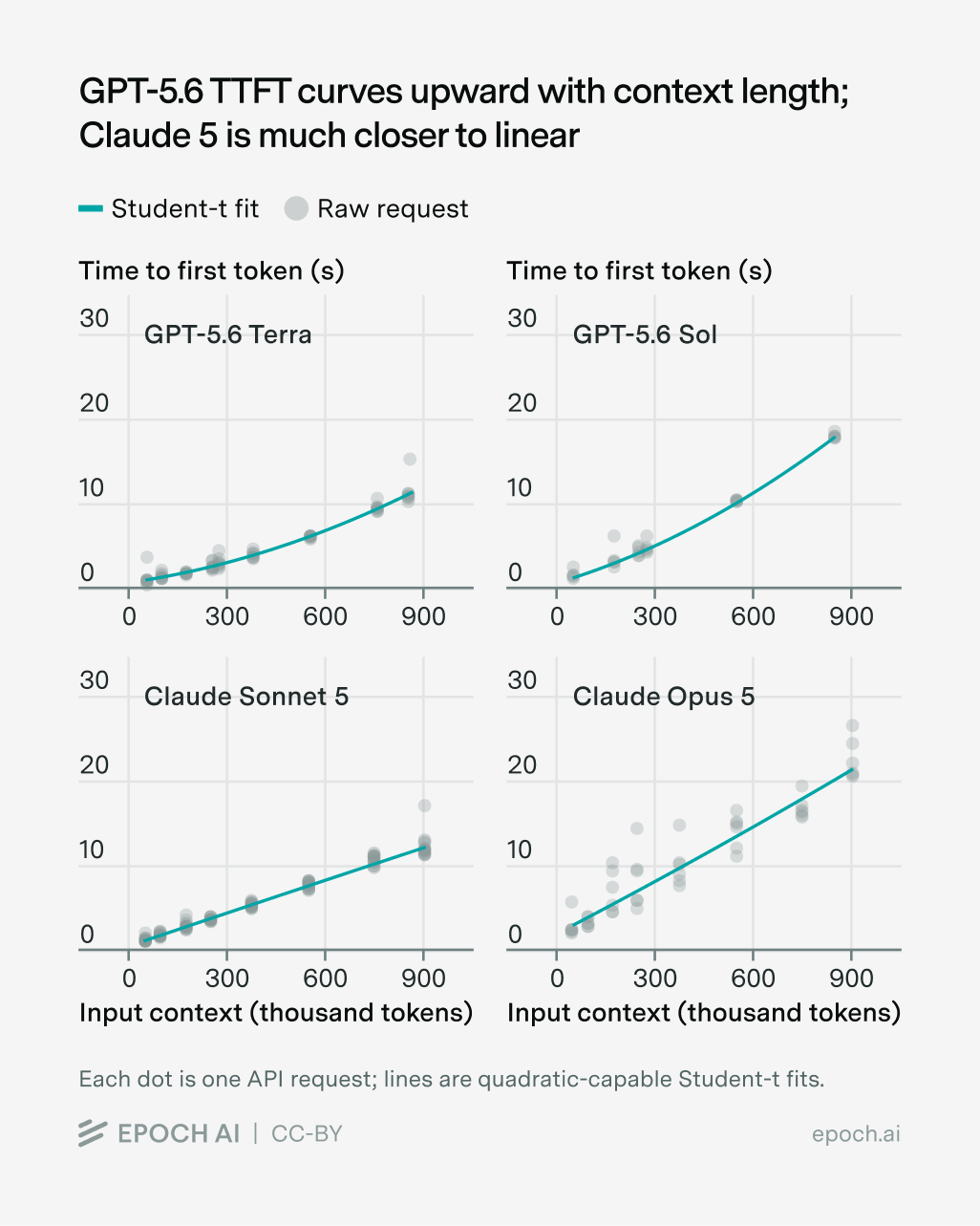
Li studied time to first token (TTFT) on these models and how it scales with increasing context length up to one million tokens. He found a significant difference in how they scale, with GPT showing a noticeable quadratic component, while Claude models remain closer to linear.
Data Insights
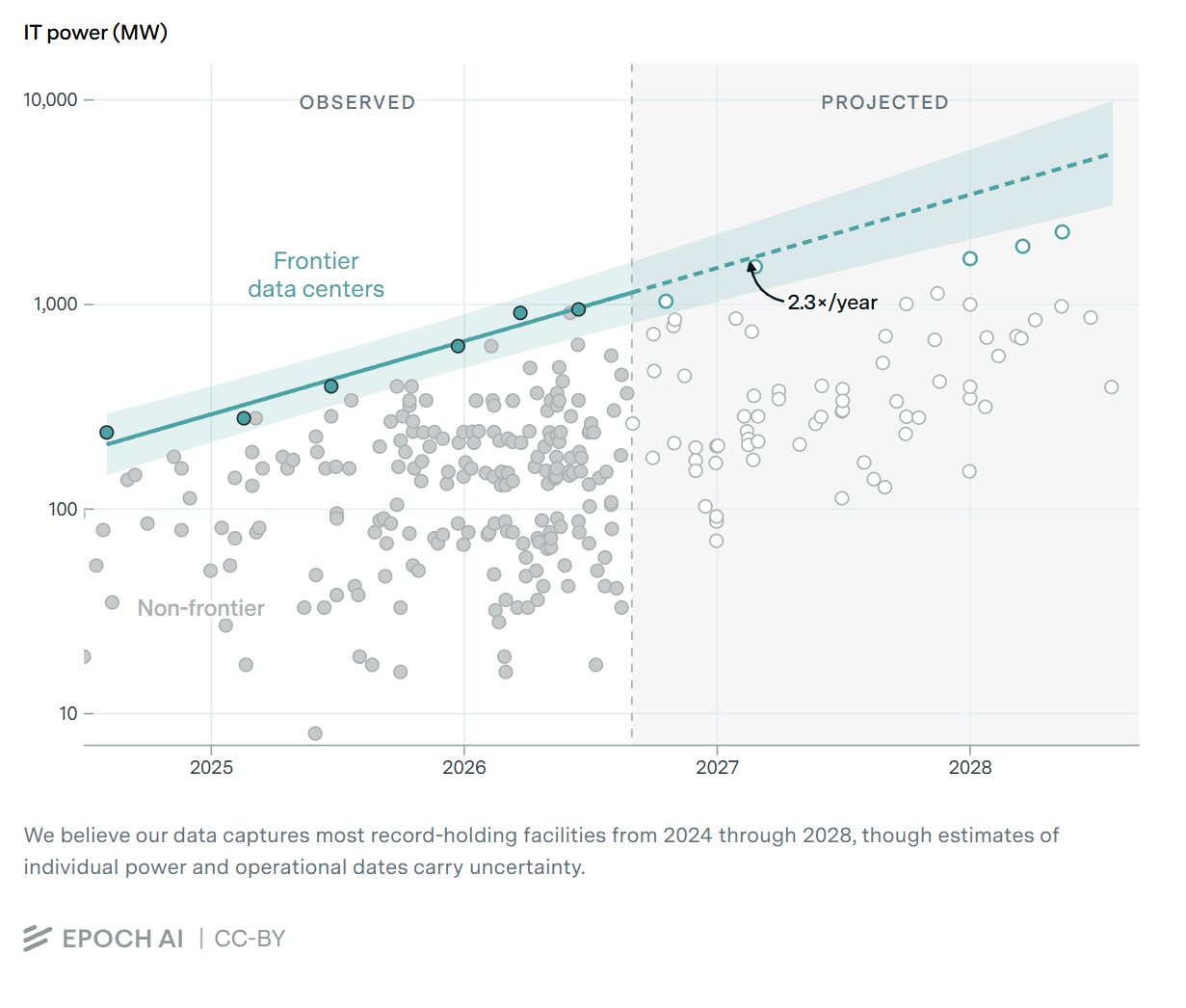
The record for power capacity in a single data center has doubled every 10 months
AI data centers are using exponentially more electric power. Since mid-2024, the record for the largest AI data center by IT power capacity has doubled every ten months. The current record-holder is SpaceXAI’s Colossus 2, at an estimated 950 MW.
The ECI frontier has advanced by 14 points per year since the introduction of reasoning models
Following the introduction of the first reasoning models (OpenAI’s o1-mini and o1-preview) in September 2024, the Epoch Capabilities Index (ECI) frontier has advanced linearly by 14 points per year, compared with 6 points per year for non-reasoning models.
Commentary
An update on AI’s most important number
In 2025, Anthropic and OpenAI were already among the fastest-growing companies of their size in history. And yet, their revenue growth has accelerated in 2026. Researcher Josh You and Lynette Bye discuss what this means for the future of AI in the latest edition of our Gradient Updates newsletter.
Benchmarking
FrontierMath Erdős
If you’ve followed AI math capabilities at all this year, you’ve likely heard of Erdős problems. Some of the first open math problems to be solved by AI were Erdős problems. The first unequivocal “wow” moment for AI in math came on an Erdős problem. Erdős problems have become something of a central benchmark for tracking AI math capabilities, but this status is relatively informal. Our new math benchmark, FrontierMath Erdős, aims to add rigor to using Erdős problems to measure AI math capabilities. Read the full write-up by the project leads.
Evaluating GPT-6 Astra
We benchmarked GPT-6 Astra, released on September 3, across multiple of our benchmarks. Astra set multiple new records, including on the Epoch Capabilities Index, taking the top spot among the 247 models we track. OpenAI provided us with pre-release access to run our evaluations.
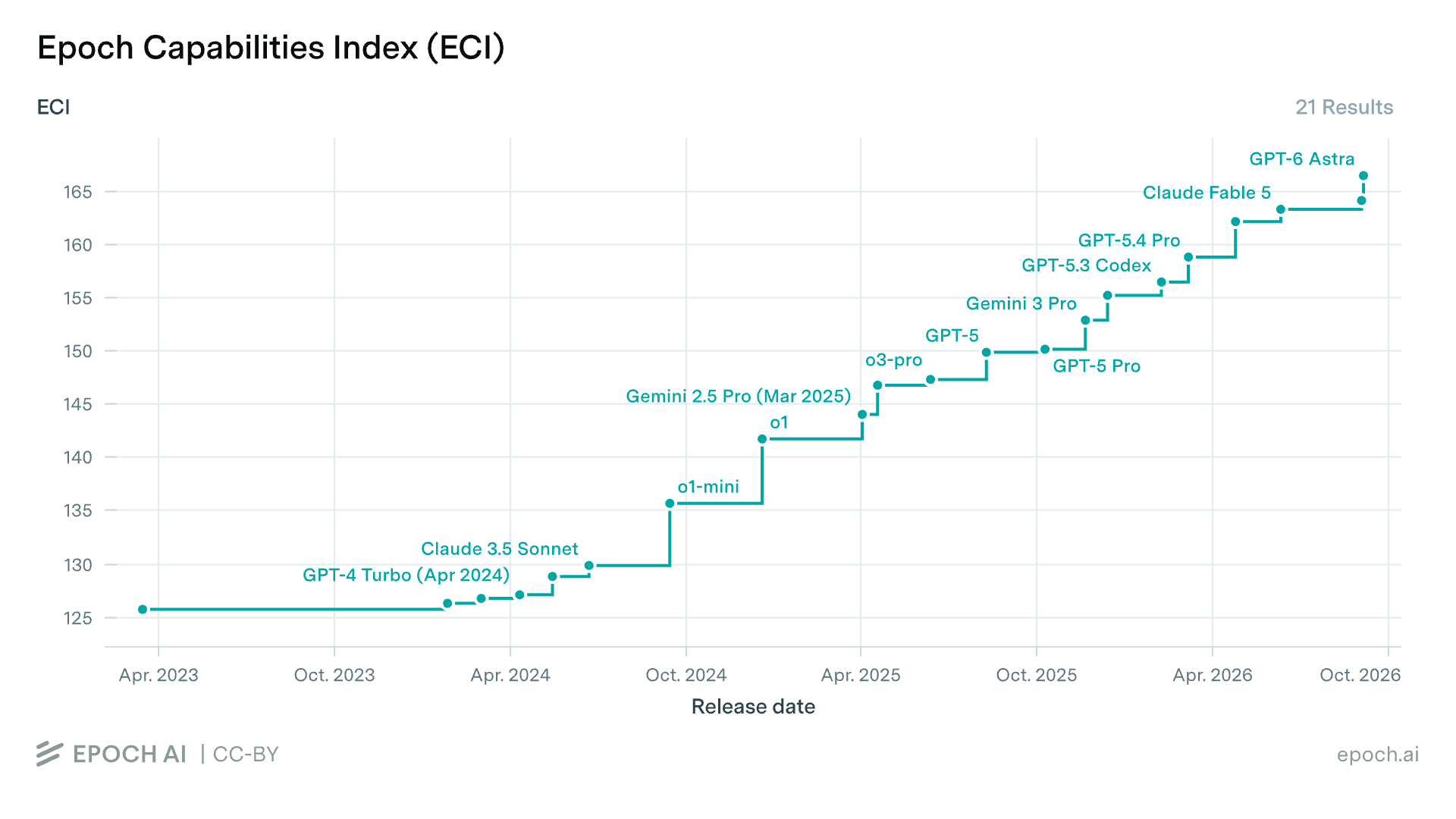
On math, Astra solved one new Moderately Interesting problem on FrontierMath: Open Problems, and is the first to solve any problems on FrontierMath Erdős, cracking 2/68. It also scored 98% on FrontierMath: Tier 4, solving the only remaining unsolved problem, leading us to consider the benchmark saturated. See our X thread for more benchmark results.
Other Updates
AI Chip Users explorer
Our new AI Chip Users explorer provides estimates of the computing power frontier developers use across research, training, and inference. We estimate OpenAI has grown its compute 17-fold in just two years, the sharpest example of an industry-wide surge. Read more about the findings in a write-up by researcher Josh You, or explore the data yourself.
Careers
Epoch is growing quickly, and we need excellent people to help us scale what we can cover. We’re currently hiring for:
Researcher / Senior Researcher: lead original research on AI trends, compute, and economics.
Data Scientist: build and analyze the datasets behind our public data hubs.
Software Engineer, Benchmarking: build the infrastructure that runs our model evaluations.
Senior Product Designer: shape how our data and explorers look and feel.
Writer & Editor: turn technical research into clear, accurate writing for a broad audience.
Social Video Producer: bring our research to video-first audiences.
IT and Security Specialist: keep our systems and data secure as the team grows.
If none of those fit, you can also submit a general Expression of Interest or apply for our Special Projects Associate roles. Applications are rolling, so apply soon!
ICYMI
A few more things from August that you might have missed.
Research
Most AI use at work happens on free plans, except in science and tech, August 14, 2026
The performance per dollar of AI chips purchased each quarter has grown by an average of 49% per year, August 13, 2026
Commentary
9 big questions benchmarks can help answer, August 14, 2026
Will financing bottleneck AI compute? An Anthropic case study, August 12, 2026
Love these kinds of succinct but deep-cut summaries. How much is known either mechanically or tacitly about the drivers behind why the OAI models scale quadratically on long contexts? Like in other words have people derived or inferred many of the relevant distinctions in the architecture?