
This is a summary of a longer report on our website.
Anthropic’s Dario Amodei has described a future “country of geniuses in a datacenter”, but could we actually see AI spitting out a country’s worth of labor in the next few years?
AI companies are shelling out hundreds of billions of dollars each year on chips and data centers, betting that the massive compute buildouts will run AI agents capable of doing work that people do today. How much work could that hardware actually do?
Our research found that the compute produced over the next two years could support tens to hundreds of millions of AI agents using today’s most capable models, or billions running cheaper ones. At that scale, AI agents could easily log more hours than all US knowledge workers combined do today.
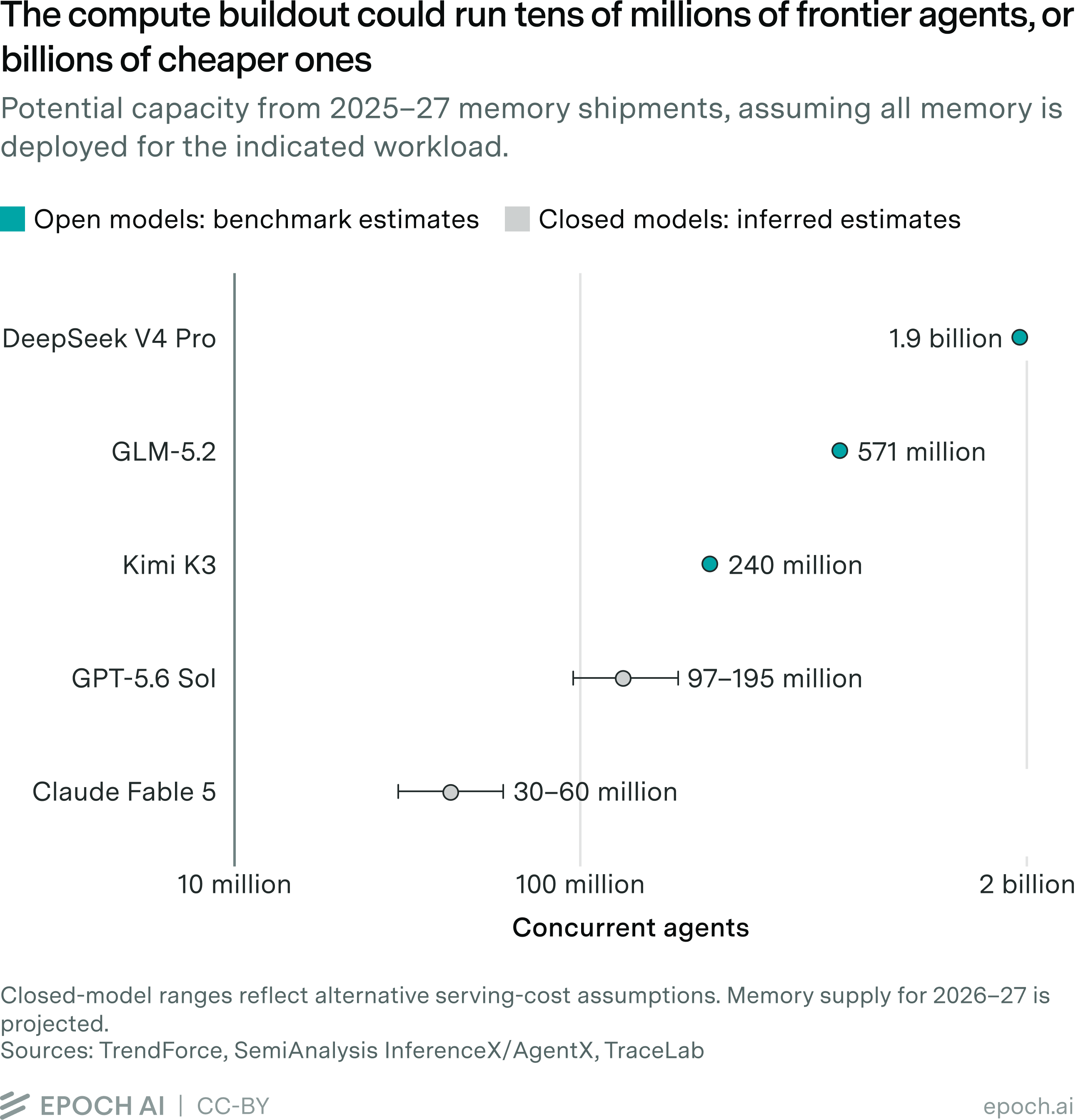
Since AI compute hardware production is bottlenecked by the availability of high-bandwidth memory (HBM), we used projected HBM shipments from 2025 through 2027 to calculate the number of GB300-equivalent GPUs that could be produced. Data center construction and other deployment constraints could delay when this hardware comes online.
We multiplied that GPU count by the number of concurrent AI agents that could be run per GB300-equivalent GPU. An agent here is one continuously running session of a model like those behind Claude Code, OpenAI Codex, or Meta’s Muse.
Running nonstop, including nights and weekends, these top-tier agents would supply as many weekly working hours as about 140 million to 700 million full-time employees.
With more efficient models, that same hardware could support billions of agents. Applying DeepSeek V4 Pro serving benchmarks to the projected hardware supply gives approximately 1.9 billion concurrent agents under our central hardware assumption. Running nonstop, these agents could match the working hours of 8 billion full-time workers.
For scale, the United States has a population of 342 million and an estimated 100 million knowledge workers. Furthermore, the above comparisons count working hours alone. Agents can also work much faster than humans, though the quality of that work varies.
AI companies could earn immense amounts from this digital workforce. Leading model developers’ revenues were already growing faster than those of any company their size in history. If they continue the recent fivefold annual growth, their annualized revenues will reach roughly $1 trillion by the end of 2027.
Yet, our estimates imply companies may be building for an even faster growth rate. If we conservatively assume that only 20% of the total compute serves revenue-generating inference at current API prices, our main estimate would imply between $2.6 and $5.3 trillion in annual revenues.
However, there’s no guarantee AI companies will actually earn that much. The key uncertainty is whether demand grows fast enough to justify the investment or whether the exploding supply leaves a glut of AI agents.
This is a summary of a longer report on our website.
'at current API prices' is a big assumption given the well established trend of a 50% drop in API prices per quarter. Of course, intelligence being even cheaper than your assumptions only strengthens the point about how much knowledge work will shift to AIs.
Almost like a doomsday prediction for millions of workers around the world. Unless there is safeguards of some sorts, what kind of Economy we are going to have?