
This is a summary of a longer report on our website.
Would you be surprised if the sticker price on a new car fell from $50,000 to $296 in two years?
Because that’s how fast AI is getting cheaper.
Over the past five years, the price of thought — the cost for an AI to hit a particular benchmark score — has fallen 13× per year. It seems to be a faster pace than any other transformative technology has matched: it’s four times faster than DNA sequencing, six times faster than compute, 18 times faster than lithium batteries, and (in the century up to 1973) 54 times faster than electricity. (OK, we don’t have good data on the price of the wheel right after it was invented.)
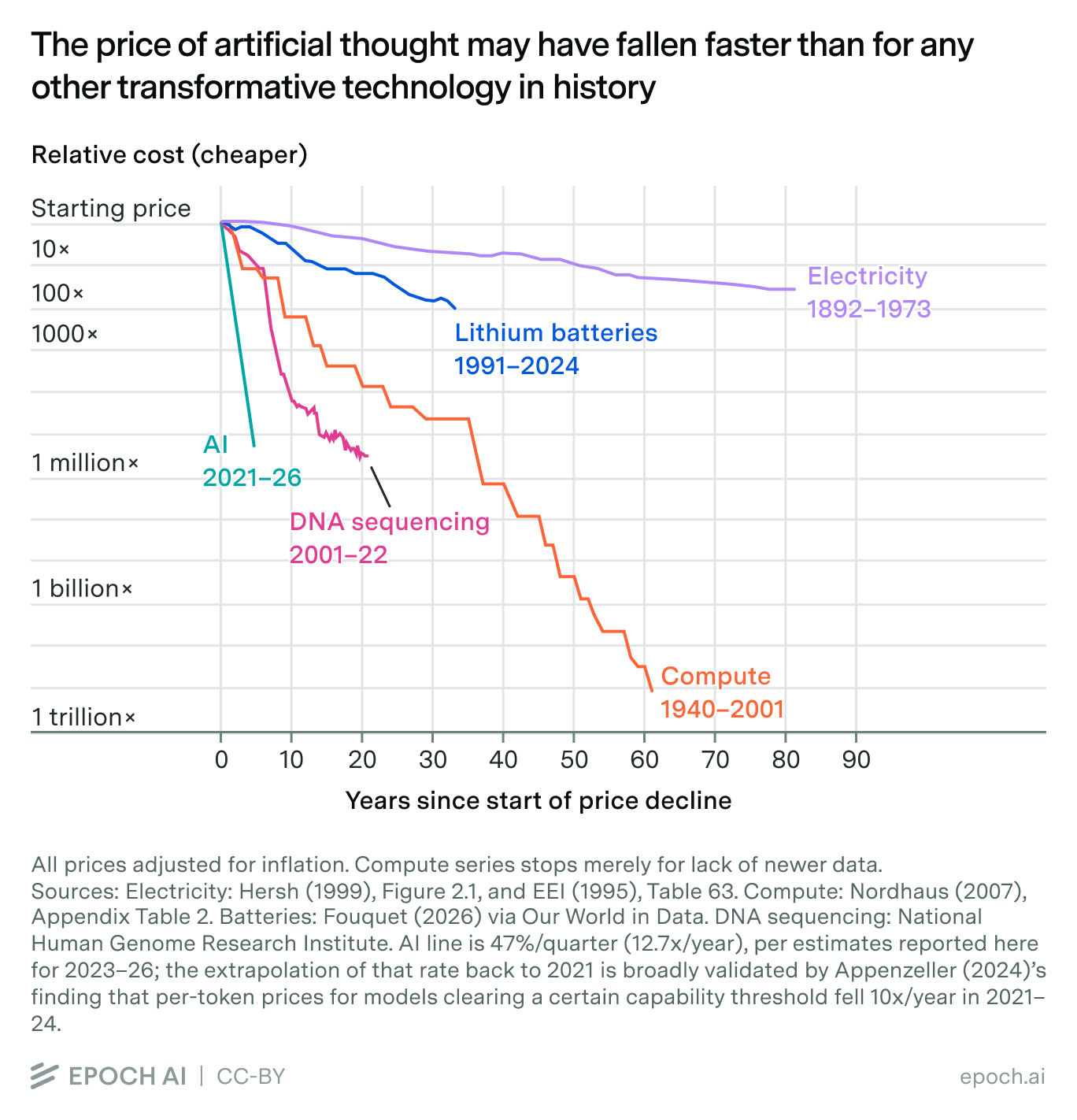
We measured the cheapest way to hit benchmark scores over time
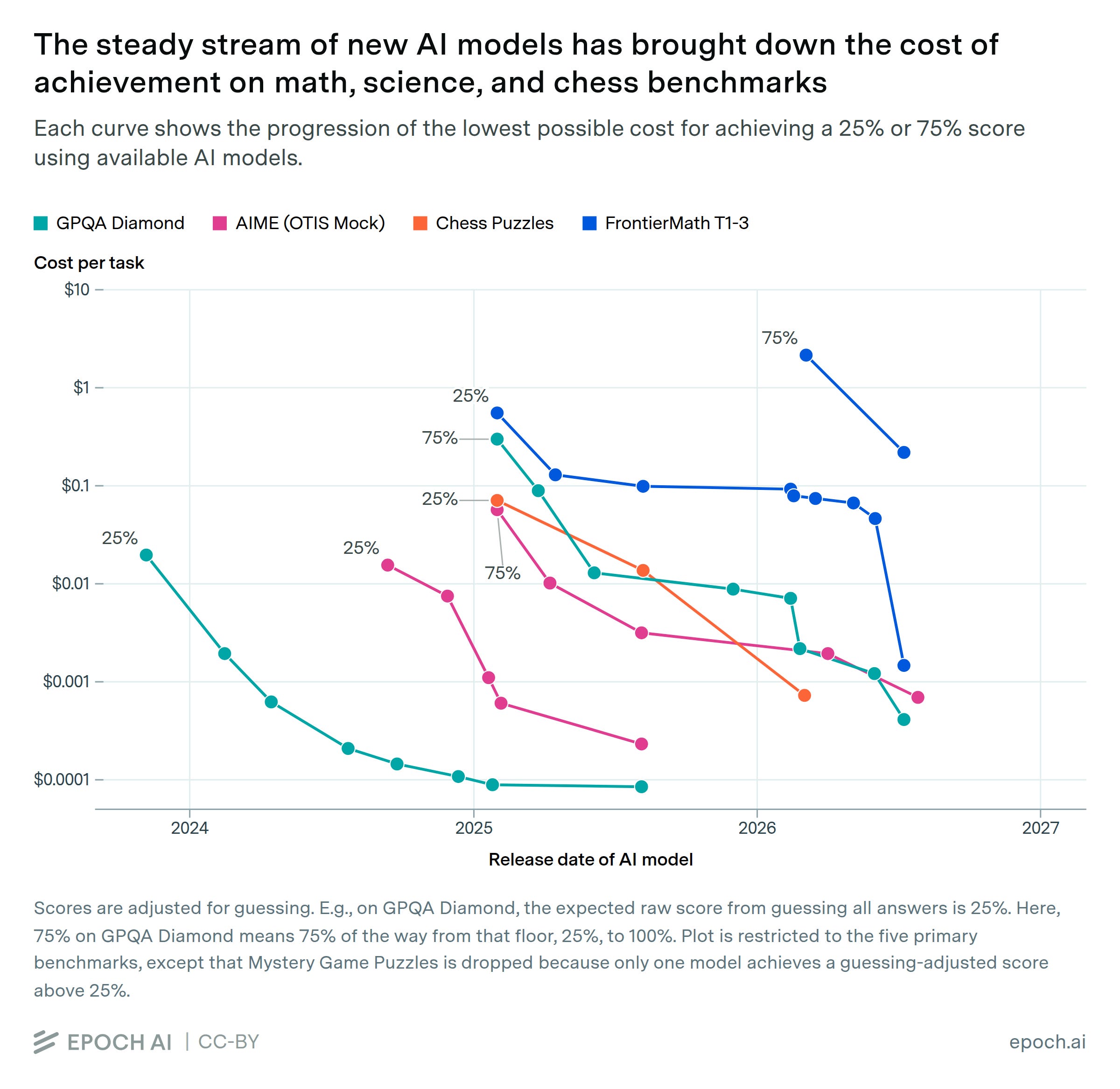
To investigate this trend, we calculated the cheapest way of hitting a given score on five AI performance benchmarks covering mathematics, hard sciences, and games of skill (e.g., chess) at different points in time over the last three years.
For example, on January 31, 2025, OpenAI released a new iteration in its series of “reasoning” models, called o3. We estimate that for an average cost of 30 cents per question, it could achieve a 75% score on GPQA Diamond, a multiple-choice exam covering PhD-level physics, chemistry, and biology. Just under 18 months later, OpenAI released GPT-5.6 Luna. It scored just as well — for four hundredths of a penny per question ($0.0004). That is a 725-fold drop in the price of thought in under 18 months, equivalent to the sticker price on a new car falling from $50,000 to $69 in only a year and a half.
This pattern of plunging price holds across benchmarks of math and chess skills too:
Coarser evidence suggests that this rate goes back to the dawn of commercial LLM inference in November 2021, when OpenAI fully released GPT-3.
That said, benchmarks are an imperfect proxy for what AI actually costs in the market or how that price compares to other technologies. Overall, we believe that our numbers are reasonably representative of reality, but they should not be read as exact.
Prices fall 13× per year; fastest soon after they release
We find that the price for a given level of performance has fallen about 47% per quarter, or 13× per year. We see slower drops on game-based puzzles, at about 39–43% per quarter (7–10× per year), and faster progress on math problems, at 50–52% per quarter (16–19× per year).
The cost decline for each given level of performance tends to slow down over time. Cost falls 66% per quarter (75× per year) at first. Two years later, it falls half as fast, at a “mere” 32% per quarter (4.7× per year). One possible explanation: when a performance level is first achieved, AI companies can briefly charge a premium for it, before competition and technological improvement quickly drive down the price. In time, that dynamic slows.
The cost of AI has been plunging for the past five years at rates unmatched by any of our reference technologies. Whether this trend continues — and what it means for the industry — are questions that only the coming years can answer.
This is a summary of a longer report on our website. Data and code are on GitHub. An overlay page has many plots and tables to explore.
This is the right number to publish, but I think the interesting series is the one it doesn't measure. The price of thought as defined here — cost to hit a benchmark score — is the price of cognition. The price of completing open-ended work in production is cognition plus everything around it: the retries, the scaffolding, the verifier, the human who signs off before the output touches anything real. That second price is the price of trust, and I'd expect its curve to be much flatter than 13x/year. If you're pricing actual agentic work, what you want is the cost per completed, checkable task — and I suspect that series would make this chart look like two different technologies.
How do you take into account losses by AI companies? One big difference across these technologies is that only AI had a huge VC/ investor backing that is allowing AI companies to make significant losses while building the technology. Falling prices is then only partly a story about better (cheaper) technology as price partly fall because firms subsidize users.
It would be interesting to know how the figure were to change if you added the losses or at least operating losses (per compute) to the AI figures. I assume the curve would be much flatter.